Thursday, May 17, 2007
Turning points
I'm spending a lot of time reading. I've just finished the Post-Birthday World by the prickly Lionel Shriver. If you haven't heard of it yet, the basic plot is: stable partnered woman gets crush on a friend, a dangerous, sexy man. There's a turning point early in the novel, on his birthday. Then the novel splits into two, Sliding Doors style. In one, she kisses him and there is the fallout from that, over the next ten or so years; in the other, she resists kissing him and goes back to her comfortable, sensible relationship and its trajectory over the next ten years. The interesting thing is that, in Shriver's hands anyway (and I suspect it's true), there is no right decision - each path has its pitfalls and rewards.
It was engrossing. I like Shriver's style, although she seems to have a bug with feminists in this novel. Her protagonist thinks things like, 'Feminists wouldn't approve, but Irina had always preferred sex doggy style' (I never said anything of the sort!) (that's not an exact quote by the way)
It got me to thinking about turning points and how my life would be different if I'd made different decisions. A lot of the decisions in my life don't feel like real turning points, places where my life could clearly have taken another direction due to my own choice. It's overall been more a case of one step after another. Obviously this pregnancy is a huge turning point, but it's not a single choice I have made - mostly it's been out of my hands. Deciding on university courses, moving states - they've all felt like incremental, inevitable changes.
There is one place, though, that feels like a real turning point. Although I hasten to emphasise that I have been a lesbian since I was 21, when i met Lovergirl I was having an affair with a man. He was in another city and another relationship, so was keen on being discreet; so it was easy for me to 'pass' as a lesbian where I was living without anyone catching me in rampant heterosexual activity in a restaurant. He was smart and interesting and very political, and there was a lot of stuff I really enjoyed about dating a man. Holding hands in public without scoping out the surroundings; the ever so slightly different response of waiters to a straight couple canoodling over canapes; and the way men don't really get into long discussions of every detail of your feelings, I found incredibly refreshing.
So when I met Lovergirl I agonised for three weeks. She gave me an ultimatum; I ended it with him. It was impulsive and rash. I'd known her three weeks; I'd been seeing him three years. But for a long time I did have that eerie sense of a possible parallel life running alongside me. A life in which I chose him, other woman and all, and became an adventurous, sophisticated mistress like those fabulous muses of old, maintaining my independence while still having a witty and sexy companion for special occasions. A parallel life that demonstrates what my life would have been like as a straight woman. Of course, sometimes in the parallel fantasy he realises he is about to lose me and gives up the Other Woman. A parallel life in which I get pregnant easily (even though, in real life, he is against having children), am part of the approved nuclear family, and my parents breathe a sigh of relief - despite a protracted period off the beaten path, at last Mikhela has brought home a man.
Monday, May 07, 2007
Free tix
Wednesday, November 01, 2006
Not doing it for me
<-- another view from my penthouseI don't mind a bit of sexy writing. Porn, erotica, smut, call it what you will. And I don't mind reading about heterosexuals doing it - my fantasy life isn't particularly fussy.
But I tell you, 'his hand was probing my cleft' is never going to work.
Not even in 'a classic work of feminist science fiction'.
If you can't do it well, you should just coyly draw the curtain and have them wake up in bed together, I reckon. I'm quite able to imagine the rest, in great detail if I feel so inclined. And it certainly won't have any clefts in it.
Friday, September 22, 2006
Vivisector 2
I have scraps of paper everywhere, with brilliant insights scribbled on them. Of course I can't find any, now that I go to post. So here are some snippets of my thoughts during these last three chapters.How was this book received? Does anyone know? I can't imagine 'nice' people approving. The novel has been uncomfortable so far - farting and fucking and constipation (what a great word is 'costive' - I'm sure I will find a use for it) and melodramatic society ladies leaving wealthy husbands and slitting their wrists over our anti-hero; but now it has moved into the frankly scandalous. Is White pulling our legs?
Why do all these women find Hurtle so attractive? Hero annoyed me intensely, with her extravagant melodramas - suicide attempts, and grand leavings for doomed romances, and of course the easily divested love for the disposable kittens and Aboriginal foster child. Does it reflect how Patrick White saw women - melodramatic, parasitic, painted and superficial? While the men are verbally constipated and bestial. I know [some] authors get very annoyed at implications that their novels are in any way reflective of their real selves. But how could they not be?
After spending the last chapter passing Nance's johns coming down the stairs with nary a twinge, Hurtle gets jealous of Olivia hanging other artists' paintings. A polyamorous patron cuts much more at his sense of specialness than competition from any men his lover has sex with.
My skin crawls at his attraction for the schoolgirl but it's interesting to experience it from inside his skin, a demon he wrestles with - finally the untouchable Hurtle is overwhelmed with feeling. I haven't thought about it much myself, but accepted the 'common wisdom' (which often turns out to be anything but) that people attracted to children are lonely losers unable to have relationships with people their own age, so seek out the admiration of the young. Does this fit with Hurtle? Kathy is presented as quite predatory and assertive, and their passion a meeting of artistic temperaments. Presumably Hurtle has had a few showers (although not enough cold ones) by now - no matter how famous he is, I find it a stretch to believe a fifteen year old would pop into bed with a frankly disgusting old man. Paedophiles justify relationships with youngsters by emphasising the child's choice, which White seems to do here. I agree children are sexual beings and the liaison doesn't seem to have destroyed Kathy, unlike the women of Hurtle's past. But what was White trying to do, giving H. an affair with a child? Kick over another taboo? Provoke? Or just say, 'it's not about age, it's about a meeting of the minds' (back to paedophile argument again)?
Kathy is the first woman on whom he he has a positive impact, releasing her creativitiy. His track record previously had been dismal - killing off Nance & Hero, disappointing Boo and Maman, and as for prickly Rhoda...some kind of uncomfortable symbiosis, each reinforcing the others' eccentricities. Maybe it was too much even for White to have him destroy a child as he had his previous lovers? Or maybe Hurtle can only adore the perfection of the potential of a child, like a blank canvas, rather than the disappointment of a completed adult.
White doesn't really create likeable characters - this is the only White I've read, and I'm not finished it yet - I wonder whether this is why people find him 'difficult' to read? The characters are difficult people.
Funny - Hurtle doesn't do that - hurtle I mean- for most of the book he has been cool, careful. While Hero turned out to be anything but, weak and desperate for absolution. Boo was the very paragon of upper class decorum. Is he using names to set up an expectation in the reader, create a tension between their label and their character?
More spot-on observations of class:
'She came in, and he thought he might not have been able to stop her if he had wanted to: entry was her birthright.' p286
Mrs Trotter could be giving a lecture to magazine editors when she says, 'Poor people only hate the rich politically - in the abstract as it were... They adore to see them in their clothes and cars.' p319
'[The maid] was so relieved to find herself loaded again with reliable chains' p371
Tuesday, September 12, 2006
Vivisector 1
'I may not be what you'd call educated,' she was beginning.'Oh God, Nance, I'm not educated!'
'But you know enough not to make sense.'
I missed the first week of commenting on the Patrick White reading group but have determined to contribute this week, despite feeling a little like Nance, overpowdered and pretending I belong, amidst bewilderment at the sophisticated literary analysis going on around me. Still, normal people could have an opinion on Patrick White too, so here's mine.
In the first week I was mightily relieved to find the book was not actually about a vivisector, but a small working class Sydney boy, Hurtle Duffield, who is sold to a wealthy family. I was really touched by the sacrifice of Hurtle's biological mother - I got the sense that she knew well that Hurtle had no prospects growing up in the slums of inner city Sydney.The first three chapters, which were discussed last week, watched Hurtle growing up in his new family, with his sadly adoring but inarticulate Father, the self-obsessed and superficial Maman, and his sister Rhoda, the frail humpback with the cruel streak of self-protection.
I've been surprised at how readable the book is. It certainly moves at a slower pace than contemporary novels, but I'd heard so much about White's turgid prose that I was expecting a real slog. This is more like - like a meal you have to chew thoroughly rather than gulping down.
Chapters 4 & 5, which are under discussion this week, see Hurtle grown up and starting to make his way as an artist. I disagreed with people who saw H as a selfish, cold child last week, assuming that it was just how some children are. But he has certainly grown up into a horrible adult, a smelly, scummy, pockmarked man who smells of piss and rubs a washcloth over his crutch and neck before going out. Errk.
I really started to dislike him when he cast aside his family so casually as an adolescent. Ungrateful wretch. Adolescents are so wasteful of family love. As a qualitative researcher, i have to bring myself into this and confess that I didn't speak to my family for four years as a young adult. For me it was necessary to find a way to stand alone, to get a sense of myself without their morals and values and expectations. So I presume that this is what Hurtle is doing, too.
Why does he tear up everyone's letters? I interpret that he hates himself - his history - he's trying to recreate himself without their demands on him
Why does he choose to be so destitute? Hurtle deliberately creates himself as a starving, isolated, eccentric artist - there's no indication in his thinking that he's mentally ill, but outwardly he looks indistinguishable from the homeless hobos clutching brown paper bags. Somehow his art comes from the slum-dwelling Hurtle, not the Hurtle that grew up in a mansion. Although i think he's fooling himself and he'd find his middle class upbringing has affected him more than he knows.
In the first three chapters, Hurtle accepted his changed family circumstances impassively. Once he left the first house, Mumma and Pa seemed to barely enter his consciousness. What a wrench, I would imagine, leaving that warm, rowdy, rambunctious crowded Duffield house for the sterile aloofness of the Courtneys. Now we start to see the hurt and anger and confusion that his experience as a pawn has left him with:
It was his worst perversion: to have hung onto a ring, long after the money was spent, the five hundred they sold him for.
This is the first time I get a sense that Hurtle has any feelings at all about his change of family.
For me, White really captures our ambivalence around class in Australia. As a child, Hurtle yearns for the Courtney's life. Once installed there, the stiffness and strictures of the middle class keep them at arms length from each other. Now, he has cut himself off from the family, taken up with a rough speaking whore who is somewhat similar to Mumma with her fascination for the trappings of the rich. He throws aside the ring, his only connection to his family of birth. His feet grow horny and he builds himself what sounds like his own slum, way out in the bush. He encouraged [his body] to coarsen, to resist values he might still find himself longing for.
I'm annoyed with Hurtle at this stage of the book. Maybe his rejection of the middle class, after experiencing both, challenges my own incompetent frantic scrabblings up from a childhood built on the western suburban wastelands of Mediterranean migrant labour. Why on earth would you throw away trips to Europe and well spoken acquaintances with vast libraries and charity works?
I like White's little joke, where he has Nance say, when she is berating all men for being self obsessed and only wanting to see in their partner a reflection of themselves, 'At least poofs are honest!' (I can't find the exact quote now)
By the way why does the grocer - a respected village ex-councillor - masturbate into the lantana under the lamplight? Do men do that? Eew.
Saturday, August 12, 2006
ex libris

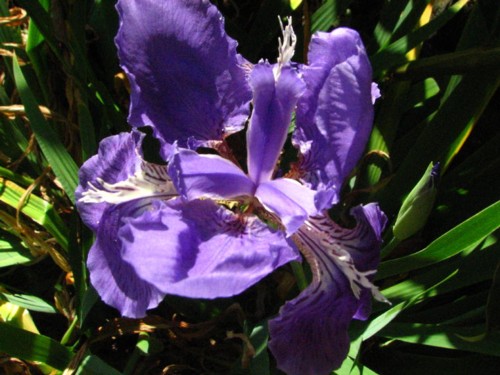
Spring is imminent - Lovergirl's irises are blooming in the garden and whenever I leave the door open the study fills up with mosquitos, those annoying heralds of summer. We are having debates about whether to light the fire at night, rather than huddling around it as soon as the sun slips behind the Nightcap ranges.
Susoz from Personal Political has 'tagged' me with a' meme'. This is a whole rite of passage and indicates that I am leaving the constraints of the bio-world and launching into the blogosphere. (At the moment I only inhabit the lower altitudes). The netiquette of the occasion warrants some explanation for non-bloggers.
Glossary:
Tag - Seems to be like playing tag, as in someone points at you, blogwise, and it is your turn to do whatever.
Meme- I think the term is borrowed from evolutionary science, that is, the way units of culturally accepted practice get passed on. In blog world it is usually a little verbal game of some sort.
Blogosphere - where those of us who blog reside, electronically speaking.
At the end of this I have to tag five more people, which is going to be difficult as any readers I have are blogless lurkers.
Lurker - Person who reads blogs without ever commenting. It's neutral, even polite to lurk for a while before you join the conversations already happening. And far better than being a troll, who is a person who invades blogs especially to be annoying, vindictive, puerile and insulting.
So here it is (I feel a pull to list highly literary books, but will resist and reveal my shallow soul...)
1. One book you have read more than once
Oh, nothing would come close to the number of times I have re-read my Narnia books.
2. One book you would want on a desert island
A big book so I could get some shade from it...and something incredibly long and fat that I would never otherwise read. War and Peace, perhaps - that would keep me going until the rescue boats arrived.
3. One book that made you laugh
This is the one I'm anxious about - what makes one laugh is an indication of so many things - intelligence, politics, cultural norms...anyway here goes
Jane Austen makes me laugh - she's so spot on with her observations of social manoeuvrings. (i.e. Mikhela is shallow and frivolous)
Also Oliver Sacks' "The Man Who Mistook His Wife for A Hat" (i.e. Mikhela laughs at people with disabilities)
4. One book that made you cry
The Tyrant's Novel by Tom Kenneally. I read it on a 24 hour bus trip from Port Hedland to Geraldton, and cried until at least Karratha. I figured the people on the bus must have thought I was escaping domestic violence or something.
The Kite Runner was also devastating.
5. One book you wish you had written
Oh...some thought-provoking social commentary like 'Writings on an Ethical Life" by Peter Singer.
6. One book you wish had never been written
Malleus Maleficorum, the handbook for identifying and interrogating witches. I think men hated/feared women well before this, but for sheer destructiveness it was pretty impressive, and still reverberates today.
7. One book you are currently reading
At the moment I'm reading Freakonomics, by Stephen someone. It's fascinating, believe it or not, using economics to analyse things like crime rates and cheating in high schools and the impact of your name on your social class. I don't trust him; he says some things that are pretty outrageous. But I'm enjoying finding out how economists think, given economics carries such weight in our society.
8. One book you have been meaning to read
The Line of Beauty by Alan Hollinghurst. A friend lent it to me, it's been sitting on my shelf for ages. I tried it once but really didn't warm to the lead character.Everyone tells me it's fantastic, so I'll have to try again.
9. One book that changed your life
I somehow fell in with a feminist crowd at uni and read a bunch of books that collectively changed my life. Some of them are Woman on the Edge of Time by Marge Piercey; The Women's Room - Marilyn someone; and Man-Made Language by Dale Spender. I was a very conservative, obedient child and these books opened up a whole new way of seeing society.
10. Now tag five people:
Okay lurkers - feel free to post yours in my 'comments' section (all you have to do is click on the little 'comments' below, try it and see)
Katya
Mel
Hilary
J in Mullum - you don't have a pseudonym yet - Jessica? Jodie?
Zedd